In Mazatlan, Mexico, there is a famous old restaurant called "The Shrimp Bucket" on the malecon- the avenue that runs along the sea-wall. Many a shrimp and a margarita have been consumed there out on the front porch, happily gazing at the Pacific Ocean. It's still a wonderful place to go.
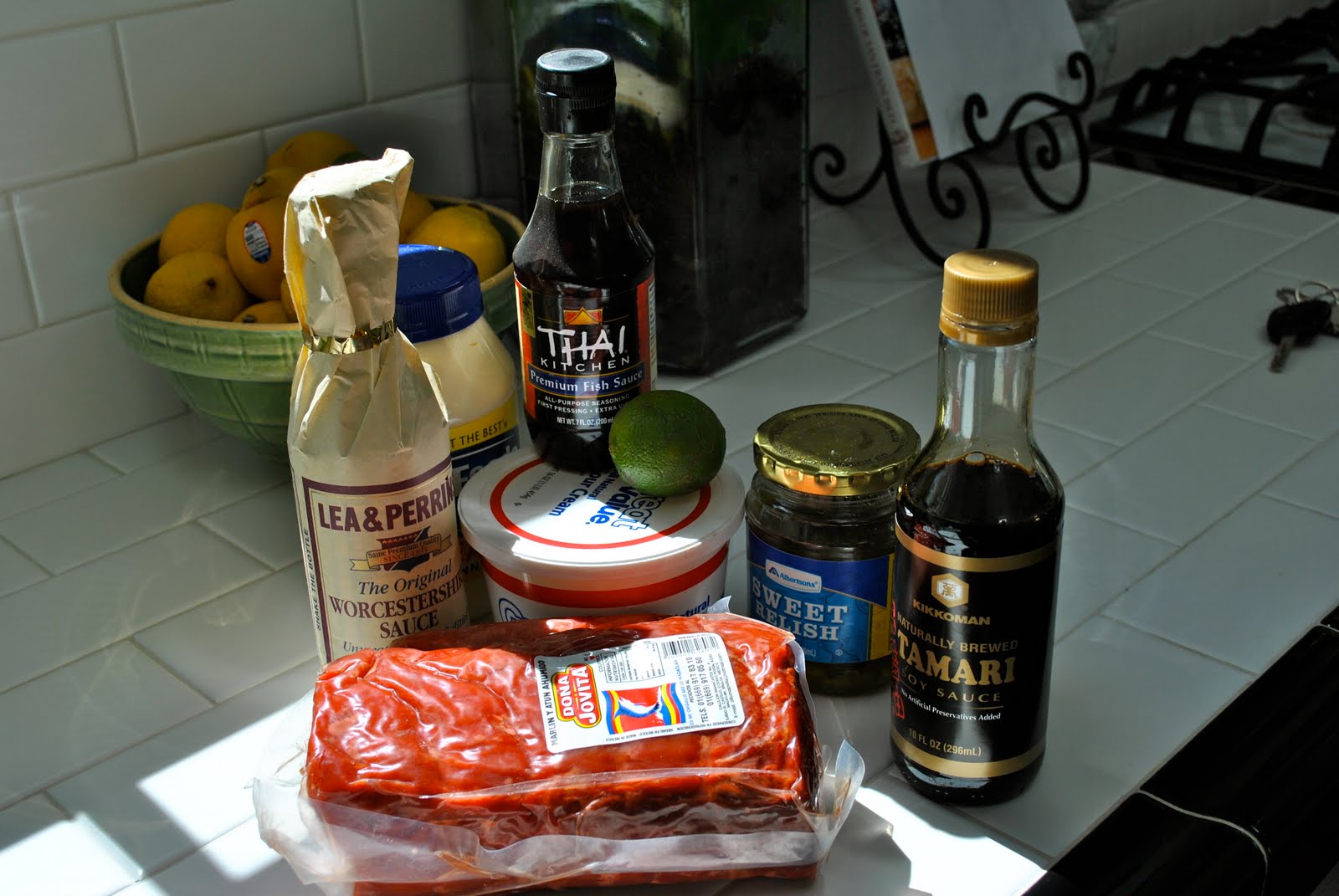
They have an appetizer there, usually served in a leaf of a purple cabbage, and with delicious freshly cooked tostadas (see prior post) that I just love. So naturally, I went about getting myself some smoked marlin and re-creating it.
Now, I'm not sure how this works, but it seems that the smoked "marlin" that one buys in Mazatlan may not be marlin, but tuna. As you can see on the package that I bought, it says Marlin y Atun Ahumado. Marlin and Tuna Smoked. So I suppose they must not be discernably different in taste or texture. I'd sure like to know more about this. However, to continue...
Smoked Marlin/Tuna Dip
1/2 kilo or 1+ pounds of smoked fish
1/2 block of cream cheesse
1/2 c. good mayonaise
1/2 c. sour cream
juice of 1 lime
1T. soy sauce
1T. worchestershire sauce
3T sweet pickle relish
1T hot sauce or 1 chipotle jalapeno adobo
1 tsp. thai fish sauce (optional)
Place all in a blender or food processor and mix until smooth.
This is delicious and unusual. Sit back and enjoy people saying "What is this?"
Showing posts with label Mazatlan. Show all posts
Wednesday, June 23, 2010
Friday, March 19, 2010
Mazatlan Sourdough Bread, Part 2
This is my waaay-easy, almost knead-less bread recipe. It only involves using the starter 7 hours before you make the bread. So sometime in the morning, put 2 ladlesful of flourin a big bowl. I just used AP flour from Ley. Add two ladles of sourdough starter to the flour in the bowl and one ladle of water, more if your dough is too dry, also 2tsp. of salt. (Remember to add two ladles of flour and 3 of water to the starter and stir well, then put that away.)
At this point take it out of the bowl and turn it onto a floured surface. Knead it for a couple of minutes, adding more flour if it's really sticky, until it makes a pretty ball like this. You can leave it in the dutch oven to rise a while, but I found I didn't have to with the starter I used.
Put the ball of flour in a heavy dutch oven with the lid on, and put it into a cold oven. Set the oven to bake at 400F and let it bake for an hour. Take the lid off and let it cook about 15 minutes more. Then, it's done.
Wrap it in a towel when you take it out of the dutch oven. Serve with lots of good butter and wine, or course. Don't you just feel like an earth mama now? Try and not break into "I am Woman". But I know you'll feel like it.So, to recap:
1. Two large ladles full of starter in a bowl.
2. Two ladles of flour.
3. Three ladles of water.
4. 2 tsp. salt.
5. Mix well, cover, and leave in a not-cold spot.
6. When doubled, knead with enough flour to make into a ball.
7. Put the ball into a dutch oven and cover. You can let it rise a while in the dutch oven or,
8. Put the dutch oven into the oven and set to bake at 400.
9. Leave in for 1 hour, then uncover for 15 more minutes.
10. Try (it's hard, I know) to let it cool down before eating.
Mazatlan Sourdough Starter
I love to bake bread. And sourdough, made with wild yeast? It's so ... miraculous. And easy. Just look what you can do with air, flour, and water!
What is wild yeast? It's yeast that is floating around in the air, everywhere. Maybe not so much in the dry Mojave, but tons around the ocean or humid places. The day I caught my little yeastie pals in Mazatlan was sunny and breezy. All you do is mix an amount of pure water and flour, 1.5 to 1, and go outside and stir, stir, stir. Leave it outside for a while and then stir some more. Put it in a clean jar and don't screw the lid down all the way, because the little yeast organisms digest and produce co2 which will need to escape. But you'll need to nourish and grow your little colony of yeast. So, after your initial "catch" has sat in room temperature anywhere between 8 and 12 hours, take half of it and throw it away, Yes, it seems a waste, but until you have a good batch you have to do it. Then, you need to feed the remaining "batter" with more pure water and flour, in 1.5 to 1 proportion. Stir, stir, stir again, because yeast likes oxygen. Think of the remaining yeast organisms getting stronger and healthier, and reproducing at a faster rate. Do this 3 or 4 times and you'll have a lovely little Yeast farm in your jar. It should smell pleasantly tangy, sour and ... yeasty, and a little liquid will form on the top, this is "liquor" and it is alcohol. You can either stir it back in or let it drain off. I think the flavor doesn't improve the sourdough batter and when I make bread, I use a lot of starter, so I pour it out.
So, to recap:
1. Put flour and purified water in a bowl on a breezy day. About 2 to 1 water to flour. Stir well.
2. Set outside for a couple of hours.
3. Stir again and put in a clean jar or container.
4. 8 to 12 hours later, take out half, and put more flour and water in. Stir well. Cover with a loose lid and let it sit out unrefrigerated.
5. Do it again.
6. Do it again.
7. Do it again.
8. Add 2c. flour and 3c. water the last time. When it's bubbly, either use it or put it in the fridge until you do.
9. Always add flour and water every time you use some. It can go right into the refrigerator afterwards.
What is wild yeast? It's yeast that is floating around in the air, everywhere. Maybe not so much in the dry Mojave, but tons around the ocean or humid places. The day I caught my little yeastie pals in Mazatlan was sunny and breezy. All you do is mix an amount of pure water and flour, 1.5 to 1, and go outside and stir, stir, stir. Leave it outside for a while and then stir some more. Put it in a clean jar and don't screw the lid down all the way, because the little yeast organisms digest and produce co2 which will need to escape. But you'll need to nourish and grow your little colony of yeast. So, after your initial "catch" has sat in room temperature anywhere between 8 and 12 hours, take half of it and throw it away, Yes, it seems a waste, but until you have a good batch you have to do it. Then, you need to feed the remaining "batter" with more pure water and flour, in 1.5 to 1 proportion. Stir, stir, stir again, because yeast likes oxygen. Think of the remaining yeast organisms getting stronger and healthier, and reproducing at a faster rate. Do this 3 or 4 times and you'll have a lovely little Yeast farm in your jar. It should smell pleasantly tangy, sour and ... yeasty, and a little liquid will form on the top, this is "liquor" and it is alcohol. You can either stir it back in or let it drain off. I think the flavor doesn't improve the sourdough batter and when I make bread, I use a lot of starter, so I pour it out.So, to recap:
1. Put flour and purified water in a bowl on a breezy day. About 2 to 1 water to flour. Stir well.
2. Set outside for a couple of hours.
3. Stir again and put in a clean jar or container.
4. 8 to 12 hours later, take out half, and put more flour and water in. Stir well. Cover with a loose lid and let it sit out unrefrigerated.
5. Do it again.
6. Do it again.
7. Do it again.
8. Add 2c. flour and 3c. water the last time. When it's bubbly, either use it or put it in the fridge until you do.
9. Always add flour and water every time you use some. It can go right into the refrigerator afterwards.
Wednesday, February 3, 2010
Robalo Zarandeado
Meet Mr. Snook. In spanish, Robalo. He's a very unhappy looking fellow, isn't he? Actually, maybe he's a she, or was. They can change sexes at will. Or, rather, as needed. ... Wow.
Well, as I was about to say, snook are very, very fine eating.
Now, as a New Mexican west Texas land-lubber, I don't know jack about fish, but I do know where to get the best Robalo Zarandeado. Cuchupeta's in Villa Union, a pueblo 12km south of Mazatlan is famous for it's "Mariscos," or seafood. Mario, the fish-monger in the town market of Villa Union, was happy to fill me in on how to prepare it "a las Cuchupetas". This is a perfect Mexican beach meal, and you can prepare it on a grill or broil it. Note: If you grill it you must cover with foil and flip it, cooking both sides.
So, what you need to do is find your way down to Mexico and get yourself a snook. However, if you just can't get to Mazatlan, you could make this dish with any whole edible fish. The fish only needs to be gutted and butterflied. Also, you will need a tomato, a bell pepper, a serrano chile, an onion, a lime, mayonaise and mustard.
Mario scaled, gutted and butterflied a snook for me, then he cut slices across the meat, skin side down.

Sprinkle the fish with salt and soy sauce.
Then mix a cup of mayonaise with a teaspoon of mustard and the juice of a lime.
Paint the mayo mixture liberally over the fish flesh, and put it on the fins and tail because it makes it pretty when cooked.
Cut the vegetables in thin slices, and pile them on the fish.
Put all the remaining mayo in a big glop on the vegetables.
Slide it under the broiler for about 30 minutes. When you take it out of the oven, check for done-ness.
Serve with hot corn tortillas, salsa and lime, and watch for bones!
Then, enjoy the spectacular sunset over the Pacific.
Labels:
Cuchupetas,
fish,
Mazatlan,
Mexican Food,
Robalo,
snook,
Zarandeado
Subscribe to:
Posts (Atom)